

The Business Aviation Market Is Market Up 5% — So Why Is the Pre-Owned Segment Stalling?
Global departures are up 5% year over year. Pre-owned transaction growth collapsed from +16% to +1% in three months. Both things are true at the same time. Here is what the data says about why.
Richard Koe & Nick Koscinski · WINGX Research · 5 min read
|
|
Download the Full 67-page JIQ Market Barometer |
.png?width=523&height=294&name=Edition%202%20Market%20Monitor%20JETNET%20iq%20(1).png)
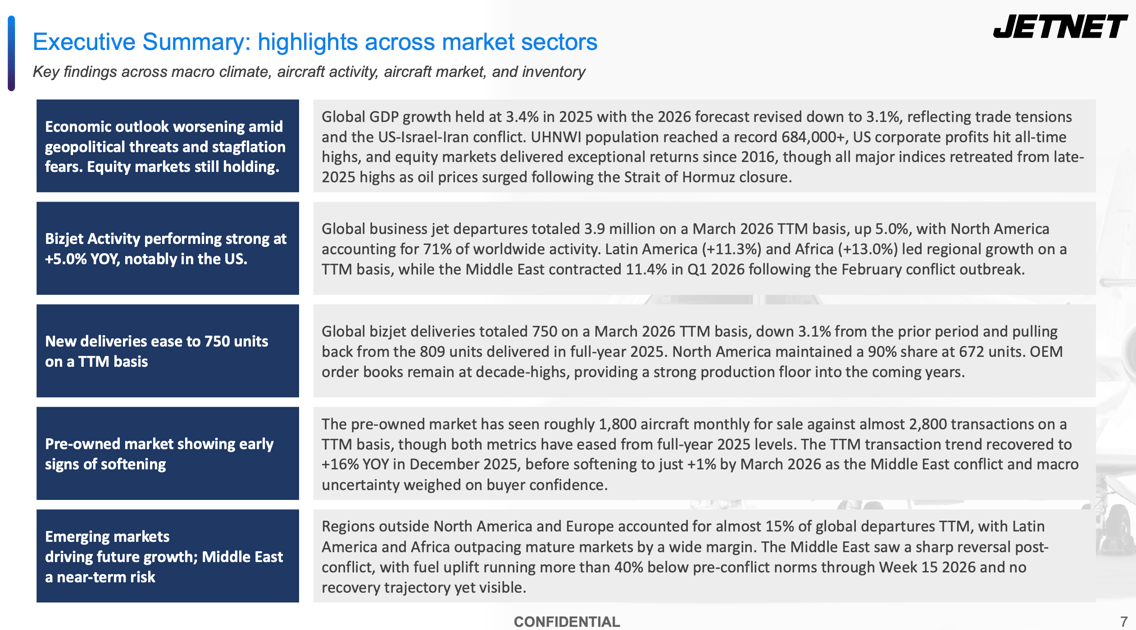
Business jet departures grew 5% in the last twelve months. Buyer confidence in the pre-owned market fell off a cliff starting in March. Both things are true at the same time, and neither one tells the full story on its own.
That split is what this month's JIQ Market Barometer is built to explain. Four findings stood out from the data. Each one points to something that does not show up in any single headline figure.
Four findings that explain the split
The full report runs to 67 pages. These four findings are the ones that tend to shift how professionals read the market — not because the numbers are surprising, but because of what they suggest when you put them together.
Pre-owned transaction growth went from +16% in December to +1% by March. Monthly data for February and March turned negative.
The pre-owned market was performing strongly through 2025. The trailing twelve-month figure still shows marginal growth, but that number is masking what actually happened. Monthly transaction data for February and March turned sharply negative. The mechanism is buyer confidence, and the data shows it moved fast once the Middle East conflict broke on February 28.
- Average days on market rose to 99 days on a Mar-26 TTM basis, up 10.3% from 90 days a year earlier
- Large Jets have fully corrected back to 2019 price levels; Small and Medium Jets are still holding above
- 75% of for-sale inventory is now 16+ years old, up from 57% in 2015 and 70% last year
- Newest aircraft (0-5 years old) represent just 5% of for-sale inventory, down from 9% in 2015
The two strongest demand predictors are both at record highs. That is what makes the pre-owned softening harder to read.
UHNWI population reached 684,000 globally in 2025. US corporate profits approached $3.8 trillion in Q4, roughly double the 2016-2019 range. Both correlate with their respective bizav activity metrics at 0.84 — among the highest relationships in the data. If the fundamentals are this supportive, the pre-owned cooling is not a structural story. It is a confidence story. And confidence can recover.
- UHNWI population projected to grow at a 5.5% CAGR through 2028, driven partly by the AI revolution and the great wealth transfer
- Global GDP held at 3.4% in 2025 but the 2026 forecast was revised down to 3.1% reflecting trade tensions and the conflict
- M&A activity rebounded to $4 trillion in 2025, best year since the 2021 peak, a tailwind for executive travel demand
The +5% departure figure is not broad-based. Fractional is pulling away from every other operator type.
Global departures grew 5%, but that number flattens a wide spread underneath it. Fractional ownership expanded 9.7% on a TTM basis, 11.3% in Q1, and 13.4% in March alone. Corporate Flight Departments declined 7.9% in Q1. Branded Charter fell 4.3%. The market is not growing uniformly. Demand is concentrating in flexible ownership models and pulling away from traditional structures.
- NetJets now sits approximately 65% above pre-COVID departure levels; Flexjet has nearly tripled since 2019
- Fractional providers captured 17% of new aircraft deliveries in 2025, up from 10% pre-pandemic
- Super Midsize Jets — the dominant fractional cabin class — average 34 hours per tail YTD, highest of any segment
- Wheels Up continues its retraction, down 20% on a Mar-26 TTM basis and now below 2019 levels
Commercial aviation disruption sent travelers to bizav in March. Washington DC bizav departures grew 18.7% while scheduled airlines fell.
A partial government shutdown in February left roughly 50,000 TSA officers without pay. Callout rates hit 42% in New Orleans and Atlanta. Against that backdrop, business jet departures grew across every affected metro in March while scheduled airline departures declined across those same cities. March 2026 recorded the largest single month of fuel uplift in the WINGX dataset. The displacement effect is real, and with multiple US airlines planning schedule cutbacks through 2026, it is not a one-month story.
- Houston: bizav +18.4% in March vs prior year; scheduled airlines -0.2%
- New York: bizav +11.3%; scheduled airlines -3.9%
- Business aviation serves 20x more unique city pairs than the top four global airlines combined
- FIFA travel demand expected to further accelerate the commercial-to-bizav shift through peak 2026 travel periods
"The fundamentals that drive long-term bizav demand — wealth creation, corporate profits, M&A activity — are all pointing in the right direction. What the pre-owned data is telling you is that short-term confidence is fragile, and right now it is being tested."
THE MONITOR FLAGGED IT. THE MARKET FELT IT.
Iran Crisis: Implications for Business Aviation
The 2025 data showed Middle East business jet activity growing 17% year over year. The conflict that broke on February 28 reversed that entirely. Regional fuel uplift fell more than 40% below pre-conflict norms through Week 15 with no recovery trajectory visible. Richard Koe joined Sheila Kahyaoglu, Al Whyte, and Bernhard Fragner on March 20 to break down what it means for operators, dealers, and investors planning into the rest of 2026.
JETNET WEBINAR SERIES · Mar 20, 2026
▶ Watch the Webinar Recap - contact richard.koe@wingx-advance.com to request access to the slides.
The Full Report Goes Considerably Further
Those four findings are a starting point. The full report covers which manufacturers have the strongest order books and what that signals, how prices have moved by aircraft type since 2019, which routes and operators are the most active, how long jets typically remain in service, and a detailed regional breakdown of where business aviation is growing and where it is slowing.
It is free to download and takes around an hour to read properly. If anything in this article raised a question, the answer is likely in there.
FREE DOWNLOAD - FULL REPORT
Get all 67 pages - the complete JIQ Market Barometer
Get the complete 2025 JIQ Market Barometer
62 pages of structured analysis combining JETNET transaction and inventory data with WINGX global flight activity intelligence - covering macro climate, aircraft activity, market transactions, and inventory dynamics through December 2025.
Built for people who work with aircraft data every day.
-
67 pages, data through April 2025 - March 2026
-
Sections: Macro Climate, Aircraft Activity, Aircraft Market, Aircraft Inventory
-
Sources: JETNET, WINGX, IMF, FRED, Knight Frank, OEM filings
-
Includes: OEM backlog, operator rankings, corridor data, fleet utilization, pricing trends
|
|
Download the Full 67-page JIQ Market Barometer
|
.png?width=558&height=314&name=Edition%202%20Market%20Monitor%20JETNET%20iq%20(1).png)